
How California Mental Health Diversion Works
Criminal Defense Attorney
Sacramento · San Francisco · San Jose · Los Angeles
What is Mental Health Diversion in California?
If you’ve been charged with a crime in California and have a mental disorder, you might be able to avoid jail and get help. A program called mental health diversion offers a treatment program instead of standing trial and possibly going to jail. Those who complete treatment will have the charges against them dismissed.
If you or a loved one have been arrested for a crime in California and suffer from a mental illness, don’t lose hope. The Rosenfeld Law Firm has helped get mental health diversion for clients facing serious criminal charges in Sacramento, San Francisco, San Diego, and more than 10 other California counties.
Do you think you or your loved one might qualify for California mental health diversion? Contact us.
Benefits of Mental Health Diversion
 |
Avoid Jail Time |
|
Avoid a Criminal Record |
|
Possibly Avoid Probation |
|
Avoid a Long and Costly Trial |
|
Get the Treatment you Need |
|
Get Back to Life Faster |
How Does Mental Health Diversion Law in California Work?
If you are arrested for a crime and facing criminal proceedings, the process for diversion will work this way:
- You must first prove you have a qualifying mental health issue. Your attorney can help you get an expert mental health evaluation.
- Your attorney will file a motion for mental health diversion.
- At a hearing, he or she will use facts and evidence to argue why treatment is a better option than a criminal trial with the possibility of prison time.
- If the court decides you qualify for mental health diversion, you will get a court-ordered treatment program.
- After you successfully complete treatment, your case is dismissed, and your record gets sealed.

Mental health diversion cases can be complex. Having an experienced attorney, such as Kenneth L. Rosenfeld, is important. The Rosenfeld Law Firm understands the ins and outs of mental health diversion in California and is ready to discuss your case. Call (916) 447-2070 to learn more.
California Mental Health Diversion Law
- California PC 1001.36 is a law that aims to help people who struggle with mental illness.
- It helps them get the treatment they need instead of punishment and a criminal record.
Frequently Asked Questions
California Mental Health Diversion
What is criminal diversion?
- Criminal diversion is a process that “diverts” certain people away from prosecution and punishment and toward alternative programs or outcomes when the traditional criminal justice system isn’t appropriate.
What is the new Mental Health Diversion Law in California?
- California’s Penal Code § 1001.36 established mental health diversion in 2018. The law was later amended (Senate Bill 1223), with four changes as of January 1, 2023:
-
- Burden of Proof – Originally your attorney would need to convince the court that your mental health condition led you to commit the crime. The new law assumes your mental disorder led you to commit the crime unless the prosecutor can prove it did not.
- Eligibility Requirements – Under the new law, most people are eligible for mental health diversion in California if they are diagnosed with a qualifying mental health condition.
- Length of Diversion – The new law shortens the maximum length of diversion from two years to one for misdemeanors, keeping it at two years for felonies.
- Definition of “Mental Health Expert” – Under the new law, you can receive your diagnosis from a case worker or social worker, not just a psychologist or psychiatrist, although a doctor’s diagnosis is best.
Do I qualify for Mental Health Diversion in California?
- To qualify for diversion, the following requirements must be met:
- You have been diagnosed with a mental disorder appropriate for diversion, as listed in the Diagnostic and Statistical Manual of Mental Disorders (DSM-5).
- The court must believe you are capable of responding to treatment and that you don’t pose an unreasonable risk of danger to others.
- You consent to whatever mental health treatment plan the court gives you.
- You waive your right to a speedy trial.
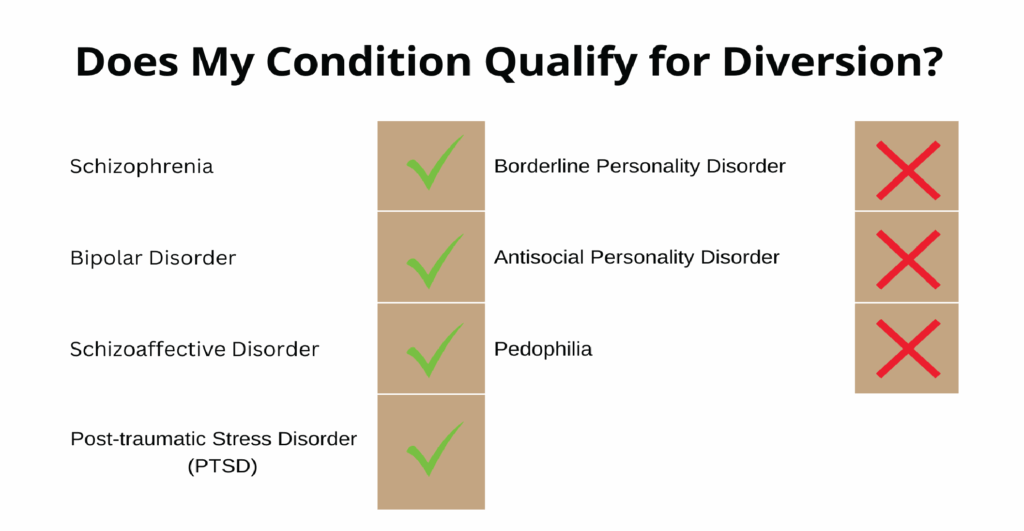
Sometimes less serious mental health conditions qualify. Learn more about who qualifies for mental health diversion in California.
Are there any crimes that don’t qualify for Mental Health Diversion in California?
- Certain crimes do not qualify, such as the following:
- Murder/voluntary manslaughter
- Sex offenses that require registration as a sex offender
- Child abuse/molestation
Do I need an attorney to get mental health diversion in California?
- Simply having a mental health diagnosis doesn’t guarantee criminal diversion. Your motion for mental health diversion has to be argued at a hearing to convince the court.
While you could try to represent yourself, it isn’t advised. You only get one chance to get criminal diversion. Your best bet is to use an attorney who is an expert in mental health diversion.
What happens if I don’t follow my treatment plan?
- If you commit a new crime or don’t follow your treatment plan, your criminal diversion could be canceled. That means you’ll have to re-enter the criminal trial process.
It’s important to have an attorney who will try to get the best treatment plan for you, so you can be successful. For skilled mental health diversion representation in Sacramento, San Francisco, Los Angeles, San Diego, and other California counties, Contact The Rosenfeld Law Firm to learn more.
How long is a mental health diversion program?
- It depends. Diversion time cannot be longer than one year for misdemeanors or two for felonies. Yours can be shorter than these maximums, but not longer.
What kinds of treatment programs are there?
- Some programs involve temporary placement in a mental health facility, while others are outpatient.
You could receive any of the following treatments: therapy, counseling, medication management, living skills development, psycho-education, and substance use treatment. Programs can be individual or group-based.
If you are granted diversion, it is the court that decides what type of program you must complete.
An attorney who is experienced with mental health diversion can help get the best treatment plan for you.
Who pays for the mental health treatment? Is it expensive?
- You might be eligible for free mental health treatment; if not, you will need to pay for it. Since payment for treatment is required for completion, it’s important to tell your attorney ahead of time what you think you can afford.
What if I don’t want to go through with mental health diversion?
- If you don’t want to do the treatment program ordered by the court, you can decline it and choose instead to go through criminal proceedings.
Mental Health Diversion: Glossary of Terms
Penal Code 1001.36
- This is the California law that allow persons with mental health issues to seek diversion.
Pretrial
- This is a criminal diversion program that is offered before a trial begins. Occasionally, attorneys seek post-plea diversion after someone has pled guilty but before they are sentenced.
Qualified Mental Disorder
- To be considered for mental health diversion, you must have an appropriate type of mental disorder.
DSM-5
- The “Diagnostic and Statistical Manual of Mental Disorders, 5th Edition,” lists mental disorders that do and do not qualify people for mental health diversion.
Competency to Stand Trial
- A measurement of whether or not a person understands the criminal proceedings and can participate in them. If you are considered incompetent to stand trial, the trial might be put on hold while you receive mental health treatment.
Risk Assessment
- How likely it is that you will commit the same crime again. It is also used to determine whether or not you are a threat to public safety.
Public Safety Risk
- You must not be considered a threat to public safety in order to get mental health diversion.
Judicial Discretion
- The court (judge) has the final say on whether or not your qualify for mental health diversion and what type of treatment program you must complete.
Probation
- This is a period of time when you can live in the community rather than jail, but you must be supervised. When it’s part of diversion, probation sometimes includes mental health treatment.
Mental Health Treatment Provider
- A psychiatrist or psychologist (or other licensed professional) or a facility that provides court-appointed treatment in mental health diversion.
Court Liaison
- The person who works between the court and mental health providers to arrange treatment, ensure parameters are being met, and gives progress reports.
Wraparound Services
- The total support services that help someone have a successful diversion, like therapy, medication management, housing, and more.
Co-occurring Disorders
- When a person has one or more disorders in addition to a mental health disorder that might impact diversion treatment, like a substance abuse disorder.
Expungement
- When a criminal record is legally cleared. Dismissal of charges is not the same as expungement.
Restoration of Charges
- If you fail to fulfill the terms of your diversion, the original charges against you will be brought back, and you will be prosecuted.
How a California Mental Health Diversion Attorney Can Help You
Getting mental health diversion can be tricky. The experts at The Rosenfeld Law Firm can help.
If you’re feeling helpless watching a loved one with a mental illness struggle with legal issues, turn to a firm with a proven track record. Attorney Kenneth Rosenfeld has gotten criminal diversion for people in San Francisco, San Diego, Los Angeles, Sacramento, and multiple other California counties. His understanding both of PC 1001.36 and of the latest mental health treatments set him apart as a mental health diversion attorney in California.
If you or a loved have been arrested for a crime California and suffer from a mental health disorder, there’s a chance you’re eligible for mental health diversion. You need someone who has the experience to make that chance a reality.
Contact Us Today
Along with legal advice, The Rosenfeld Law Firm in Sacramento, California, offers experience and representation in other pertinent areas of practice including prison law, mental health law, appellate law, and federal criminal defense.
To speak with one of our California criminal defense lawyers, for more information about the company’s law firm, or to schedule a consultation, please contact us online or call the office directly: